This library provides abstractions that help you write event-driven Arduino and mbed applications. It has device abstractions that allow you to treat device pins, PCF8574, MCP23017, MPR121 and AW9523 almost the same in code. This includes higher level interrupt management, buttons with de-bouncing, matrix keyboards, rotary encoders and even LiquidCrystalIO. There are many examples packaged with the library that cover most use cases.
For development, you can use any Arduino or mbed IDE. However, our recommendation is platformIO with Clion or VS Code. We test the library with Arduino and PlatformIO.
Need help with a commercial design, or want a customised version for your hardware, see the consultancy link at the top of the page?
Reference guide and code repo
Digital IO for Arduino and mbed
- Arduino & mbed digital IO on Pins, IO Expanders and shift registers
- PCF8574 I2C Io Expander
- MCP23017 I2C IoExpander
- AW9523 I2C IoExpander with LED Control
- MPR121 I2C IoExpander with Touch and LED control
- Using MultiIo - more than one IO on the same abstraction
- Abstracted I2C/Wire on Arduino and mbed
Analog IO for Arduino and mbed
- Using the analog abstraction for ADC/PWM/DACs
- Raising events on Analog input
- Ioa Extras - extra Analog devices
Switches, keyboards and rotary encoders
- Using switches and rotary encoders for debounced input
- Using the keyboard manager for matrix style keyboards and keypads
- Touch screen interfaces for Arduino and mbed
- Analog Joysticks for Arduino and mbed
- Tutorial: Using switches for event based button presses
- Example: Rotary encoder and buttons on PCF8574 with interrupt
EEPROM abstractions
Logging, text utilities and unit testing helper classes
- Arduino logging with IoAbstraction
- Text Utilities and helpers
- Troubleshooting, IoAbstraction mock implementations
PCF8574 / PCF8575 I2C IoExpander for Arduino and mbed
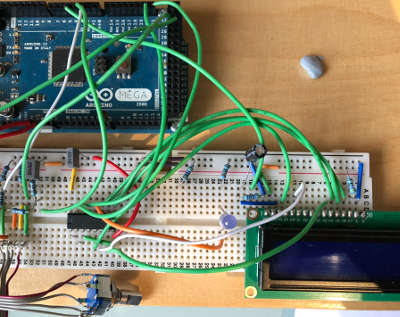
IO Abstraction library fully supports the PCF8574 8-bit and PCF8575 16-bit IO expander chips on Arduino and mbed. It requires only two pins (three for interrupt mode) SDA, SCL, and optionally INT. Our driver integrates the interrupt support for you so you can attach interrupts very easily. The PCF8574 provides 8 additional input or output ports, but there are few limitations...
AW9523 I2C IoExpander with LED controller - Arduino and mbed
IO Abstraction library fully supports the AW9523 16-bit IO expander chips on Arduino and mbed. It requires only two pins (three for interrupt mode) SDA, SCL, and optionally INT. Our driver integrates the GPIO, LED controller, and interrupt support providing nearly all functions using familiar Arduino terminology. This device can even be used in conjunction with an AW9523 analog device ...
MCP23017 I2C IoExpander for Arduino and mbed
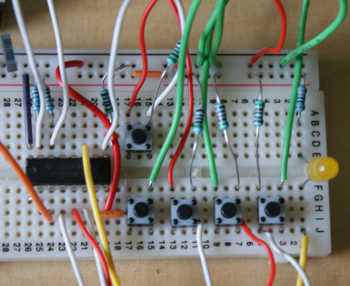
IO Abstraction library fully supports the MCP23017 16-bit IO expander chips on Arduino and mbed. It requires only two pins (three for interrupt mode) SDA, SCL, and optionally INT. Our driver provides nearly all functionality using similar terminology to Arduino itself. The MCP23017 provides 16 additional input or output ports, they have very similar capabilities to device pins and interrupt support...
MPR121 I2C Touch/IoExpander/LED controller - Arduino and mbed
IO Abstraction library fully supports the MPR121 12-bit Touch control and IO expander chips on Arduino and mbed. It requires only two pins (three for interrupt mode) SDA, SCL, and optionally INT. Our driver integrates the Touch, GPIO, LED controller, and interrupt support providing nearly all functions using familiar Arduino terminology. This device can even be used in conjunction with an...
IoAbstraction: Using a matrix keyboard / keypad
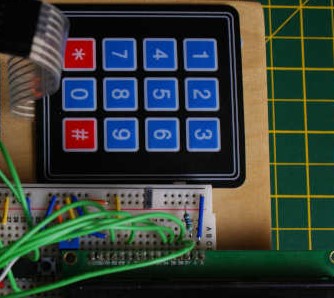
Matrix keyboards are arranged such that the keys are in a matrix of rows and columns. This means that instead of needing a spare input for each key, one INPUT for each column and one OUTPUT for each row is all that's needed. In order to use the keyboard, we create a class of type and configure it with an...
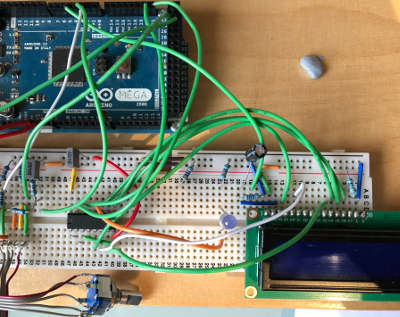
Arduino Button presses that are handled like events
Have you ever wanted to treat button presses in Arduino similar to other languages, where you get an event callback when the switch is pressed? Look no further, the IO abstraction library can do that with very little fuss. In fact it can also do the same for rotary encoders as well, treating them similar to how scroll bars work in...
Liquid Crystal fork example using IO Abstraction library - examples
Recently, I have made a fork of Arduino LiquidCrystal (HD44780 display driver library) that allows the library to work with the IO abstraction library, meaning you can configure a display to use Arduino pins, an i2c 8574 IO expander or shift registers by simply changing one line of code in your sketch. There are two additional examples provided with this version...
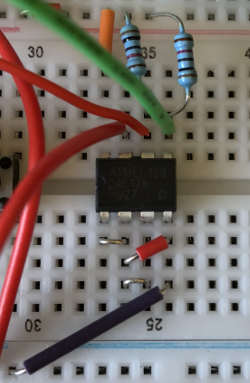
EEPROM implementations that are seamless between implementations
EEPROM support varies considerably between boards and project designs, you've probably already noticed that there's no EEPROM support on some 32 bit boards. I think that's quite unfortunate as EEPROM storage is invaluable for many applications. Relying on memory backup like many systems today do, is nowhere near as reliable (a flat battery loses everything). Further, I've even seen discussions where...
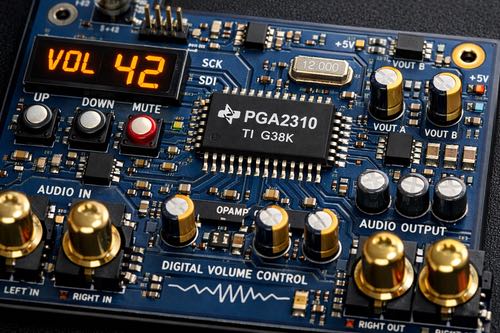
PGA2310 Volume Control device for IoAbstraction
PGA2310 Volume Control device Provides a simple analog device that can be used to control a PGA2310 volume device. Left channel is 0 and right channel is 1. The device should be connected on the SPI bus as usual. This should work with Arduino now, and mbed in a patch release coming soon. To use first include the header: Then initialise...
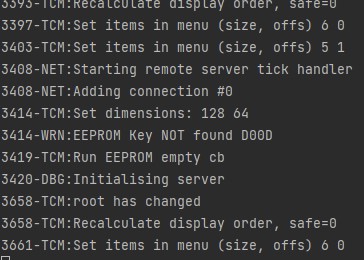
Arduino text utilities in IoAbstraction
IoAbstraction comes with a few text utilities that can be helpful when rendering text as raw character arrays. Internally, IoAbstraction and TcMenu DO NOT use any string objects to avoid runtime memory allocation. See the complete text utility documentation To use the text utilities you need to include the header Often times, we need to build text up within a buffer,...
These may be of interest
- Similar - Write XML with GroovyBuilder
- Similar - Wrapping JFreeChart as a Groovy builder
- Similar - Reading XML in groovy using XmlParser
- Similar - Generate an ATOM feed with GroovyBuilder
- Similar - Groovychart Bar chart with fixed colour

Supporting us
We maintain several popular embedded projects and work hard to make them even better. If you're looking for commercial services, please do consider us.
Alternatively, you can buy us a coffee to say thanks.
Sharing links
Learn about TcMenu
We build and maintain an embedded menu designer and framework that works on many platforms.