TaskManagerIO - Summary
TaskManagerIO provides scheduling, events and interrupt marshalling, all while remaining thread safe across a wide range of boards. By thread safe we mean that you can add tasks to task manager from another thread while it's still running. However, the task manager itself will always run on one thread, making it easy for you to write code.
This library contains the original scheduling support class TaskManager that was previously built into IoAbstraction.
Getting started and scheduling things to be done
Task manager can schedule tasks to be done either now, or at some point in the future. Available in all versions of task manager.
- Task Manager scheduling guide
- Tutorial - programming an Arduino using tasks
- Timed blink example (packaged with IoAbstraction)
- Read the reference documentation
- Go to the code repo on github
Marshalling interrupts to task manager tasks
Task Manager can add an interrupt on your behalf that is marshalled into a task execution. Available in all versions of task manager.
Polling, Interrupt based and multi-threaded events
TaskManagerIO has a complete eventing framework built into it, on top of this many types of event based programs can be built.
- Using polled events with TaskManager
- Using interrupt event with TaskManager
- Using spin-lock with TaskManager
Power management
Adding tasks from other threads
If you are using an RTOS such as FreeRTOS on ESP32 or mbed RTOS 6 you can safely add tasks and trigger events from other threads. However, you should never run the run loop from more than one thread at a time. You can however, start another task-manager on another thread.
Remember that one of TaskManagerIO's main advantages is that your embedded apps don't need to be concerned with the possibility of access across more than one thread, or working out how to handle raw interrupt handlers. Removing these from the mix allows code to be cleaner.
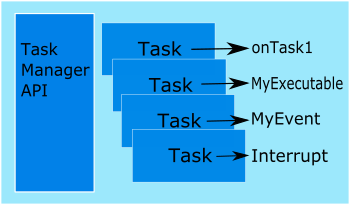
Creating interrupt and threaded events with TaskManager
In this guide we assume that you are familiar with the API for scheduling tasks on task manager. Let's first discuss what we consider an event to be, and what it means to be an interrupt or threaded event. Interrupt or threaded events are subject to external actors (such as threads or interrupts). In this case the event will invariably be...
How to create a polled event with TaskManager
In this guide we assume that you are familiar with the API for scheduling tasks on task manager. Let's first discuss what we consider an event to be, and what it means to be a polled event. By polling we mean no external actors (such as threads or interrupts) are involved. Task manager will ask your event instance frequently if it...
Scheduling tasks with Task Manager on Arduino and mbed
Using TaskManager in your sketches TaskManager is a very simple co-operative coroutines / executor framework that allows work to be scheduled in an internal queue. Instead of writing code using delays, one simply adds jobs to be done at some point in the future. In addition to this, interrupt handling is also supported, such that the interrupt is "marshalled" and handled...

Task Manager Low Power example for SAMD boards
There are often cases when you'll need to run a micro controller from a battery power source. Unlike when running from mains power, every milli-amp matters. In these cases IoAbstraction's task manager is able to integrate easily with most low power libraries. Task manager works by repeatedly calling the function within or , during each loop task manager evaluates...
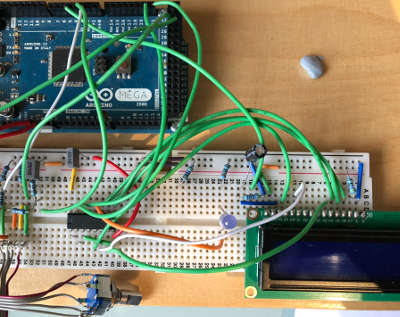
Programming Arduino using tasks instead of loops - tutorial
In this tutorial for TaskManagerIO I explain the differences between traditional loop based programming; which is very common on the Arduino platform and event based programming based on taskManager. Although event based programming looks slightly more complicated at first, as the sketch and surrounding code gets more complex, eventing will scale to that much easier. Eventing task frameworks make ongoing maintenance...
Task Manager - Spin Lock guide
Task Manager supports the concept of Spin Locks to protect sensitive asynchronous operations from becoming interleaved. For example, to protect sensitive blocks of code. Be very aware that this does not include a memory barrier. A spin lock loops waiting for the lock to become available, you can either spin for a period of time, or until the lock is...
All library - Cross platform build support
Moved, see [arduino-libraries.md] for the list.
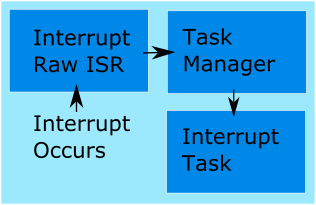
Marshalling interrupts into TaskManagerIO tasks
Interrupt handling is generally an advanced topic, but this library provides a very simple way to handle interrupts. There are two ways to handle interrupts in TaskManagerIO, the first is by marshalling, and the second is by writing an event. We recommend that all new code uses the event method to handle interrupts , although we have no plans to deprecate...
These may be of interest
- Similar - Write XML with GroovyBuilder
- Similar - Wrapping JFreeChart as a Groovy builder
- Similar - Reading XML in groovy using XmlParser
- Similar - Generate an ATOM feed with GroovyBuilder
- Similar - Groovychart Bar chart with fixed colour

Supporting us
We maintain several popular embedded projects and work hard to make them even better. If you're looking for commercial services, please do consider us.
Alternatively, you can buy us a coffee to say thanks.
Sharing links
Learn about TcMenu
We build and maintain an embedded menu designer and framework that works on many platforms.