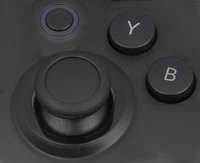
Working with Analog joysticks in IoAbstraction
IoAbstraction fully supports analog joysticks, and it does so in many modes, you can use them in three ways: You can get the values of the joystick using an directly. This is the simplest case and you would read the present floating point value as needed. You can treat an axis of the joystick as a rotary encoder, and either...
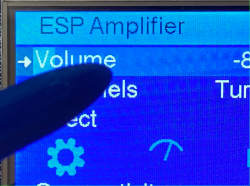
Touch screen support that works on all Arduino and mbed boards
IoAbstraction includes support for touch screens. The support is built in layers to allow for different drivers to be added over time. However, at the moment there is support for resistive touch screens on analog pins. This library can work with such touch screens regardless of analog input resolution, as long as the device is supported by IoAbstraction. As with switches...
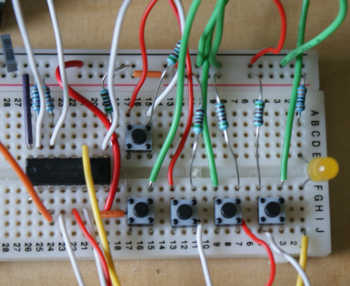
Working with Analog input events in IoAbstraction
IoAbstraction has a class named to support event based programming for Analog Inputs, it is based on the class within the base library TaskManagerIO . The class itself is very flexible and can work with both polling and interrupt based approaches, or even a hybrid of the two. If you are not familiar with events, I recommend reading about...
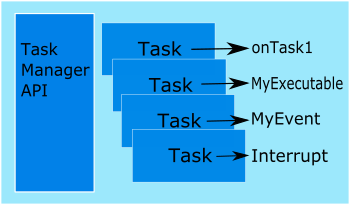
How to create a polled event with TaskManager
In this guide we assume that you are familiar with the API for scheduling tasks on task manager. Let's first discuss what we consider an event to be, and what it means to be a polled event. By polling we mean no external actors (such as threads or interrupts) are involved. Task manager will ask your event instance frequently if it...
Creating interrupt and threaded events with TaskManager
In this guide we assume that you are familiar with the API for scheduling tasks on task manager. Let's first discuss what we consider an event to be, and what it means to be an interrupt or threaded event. Interrupt or threaded events are subject to external actors (such as threads or interrupts). In this case the event will invariably be...

LiquidCystalIO with a DfRobot shield
DfRobot provides the simplest way to get started with LiquidCrystalIO on Uno and Mega (and other compatible boards). It has a display with an array of switches connected to A0 (up, down, left, right and select). This library works correctly with the display and even has a shorthand way of creating the LCD for this case. Connections to an Arduino Uno,...
Scheduling tasks with Task Manager on Arduino and mbed
Using TaskManager in your sketches TaskManager is a very simple co-operative coroutines / executor framework that allows work to be scheduled in an internal queue. Instead of writing code using delays, one simply adds jobs to be done at some point in the future. In addition to this, interrupt handling is also supported, such that the interrupt is "marshalled" and handled...
IoAbstraction Analog Core documentation
IoAbstraction has a simple interface to the analog capabilities of all supported boards. It provides frequently used functionality around acquiring and setting analog values from ADC, PWM and DACs. Having the ability to read and write analog values as float, where the value is between 0 and 1; where 0 is off and 1 is fully on. this capability allows you...
IoAbstraction: Arduino Pins, IO Expanders, Shift Registers using same code
Using IoAbstraction you can write a sketch / program that uses Arduino pins, shift registers and IO expander devices at the same time, very much like you'd normally use Arduino pins. This library also provides simple interrupt handling that again is consistent across Arduino, mbed and IO expander ICs. What do we mean by consistent, we mean that configuring a pin,...
IoAbstraction: Switches and rotary encoder documentation
Using SwitchInput for buttons and rotary encoders SwitchInput is a button and rotary encoder management library that treats button presses and encoder adjustments as events, similar to web and UI applications. Supporting as many switches and rotary encoders as you need, in an event driven way, working along with TaskManagerIO to keep your code clean. Key points: Buttons using either pull...
These may be of interest
- Similar - Belt clamps - what a find!
- Similar - Hand-built router table for the workshop
- Similar - Things learnt from building the first turntable.
- Similar - HI-FI Collective cable kit 6
- Similar - Orbit, a high performance DIY turntable.

Supporting us
We maintain several popular embedded projects and work hard to make them even better. If you're looking for commercial services, please do consider us.
Alternatively, you can buy us a coffee to say thanks.
Sharing links
Learn about TcMenu
We build and maintain an embedded menu designer and framework that works on many platforms.