TheCodersCorner.com items tagged with arduino.
Working with fixed choices - EnumMenuItems
An item that can represent a known series of values where only one can be selected at a time. Somewhat like a combo box. For enum items these values must be set at compile time, and on AVR / ESP they are in program memory. We store the choice as a zero based integer with the first choice being 0 and...
Working with scroll choice items - ScrollChoiceMenuItem
Scroll Choice menu items allow for a single choice from a list of choices. Unlike enum menu item the choices may not be known until runtime, and could change at any time. There are several ways that choices can be stored either in a fixed width memory character array, EEPROM fixed width array, or lastly using a custom callback for each...
Working with numeric values - AnalogMenuItem
Working with Analog Items An item that can represent an integer, fractional, or decimal numeric value that can be editable using a rotary encoder or touch scroll/slider control. Currently, the underlying value is a 16-bit unsigned integer value but the maximum range is from -32768 to +32767. This is because we can make it appear negative by providing a negative offset....
Detailed description of RuntimeMenuItem
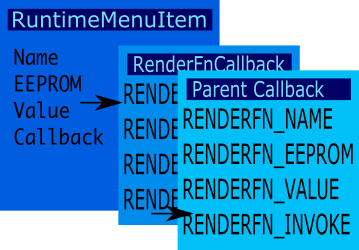
Items that extend from runtime menu item use a callback at runtime that can be used to get more or less every property, but will use the INFO block if it is available (not null). That being the case, they don't need but can use an info block (that is defined ahead of time) ahead of time. However, in...
Detailed description of MenuInfo based menu items
All types of MenuItem can have an INFO block, which is a structure that can be stored in FLASH that represents the static data for an item. This is because all items directly extend from the MenuItem class, they always have a reference to an AnyMenuInfo block that's stored in program memory on devices that support it. In addition to this,...
Heltek Wifi kit 8 pin outs marked wrongly on some silk screens
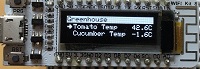
I recently bought a Heltek Wifi kit 8 and noticed that although the board itself seems to be a good board the pin-outs, both online and on the silk screen of the board are wrongly specified. For example the silk screen shows SDA and SCL on non standard pins, but this is not the case as far as I can tell....
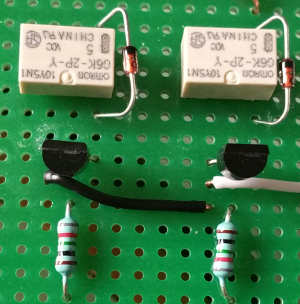
Detecting power loss in a power supply
There are times when your program needs to react to your device being turned off, for example to save the current state of an Arduino sketch to EEPROM before shutting down, or to disengage relays in a power module to ensure there is a clean shutdown. Usually, the power loss detector is designed as part of the power supply, so...
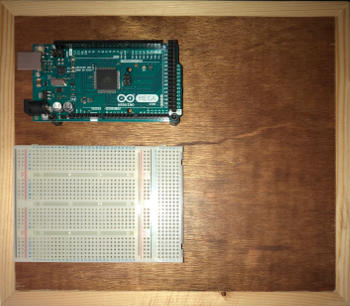
Making an arduino board holder from ply & wood
Making a nice case for an Arduino board can range from the simplest possible case , a piece of plywood the right size, with a few holes to mount the board, right through to an intricate box with closing lid etc. This one probably falls in the middle somewhere. Why another Arduino board holder you ask? Now that my son has...

Arduino digital input and output tutorial
In this tutorial and accompanying youtube video (left), I discuss how Arduino inputs and outputs work. Arduino 8 bit boards are mainly based on Atmel AVR chips, in fact the Mega is named after the chip number AVR-Mega-2560. Outputs on the AVR chips are much more versatile than they first look, and the video covers this in detail. If you are...
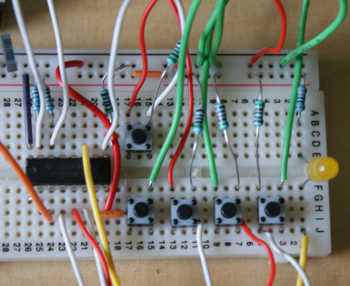
IO abstraction: the same code for pins, shift registers and i2c IO
When writing Arduino code that needs quite a few IO pins, you may need to expand the IO using a shift register or i2c expansion device such as the PCF8574. Up until now that meant significantly changing your code to use the new device. If you were using the IOAbstraction library , then you'd just set up a different type of...
These may be of interest
- Similar - Write XML with GroovyBuilder
- Similar - Wrapping JFreeChart as a Groovy builder
- Similar - Reading XML in groovy using XmlParser
- Similar - Generate an ATOM feed with GroovyBuilder
- Similar - Groovychart Bar chart with fixed colour

Supporting us
We maintain several popular embedded projects and work hard to make them even better. If you're looking for commercial services, please do consider us.
Alternatively, you can buy us a coffee to say thanks.
Sharing links
Learn about TcMenu
We build and maintain an embedded menu designer and framework that works on many platforms.