Turntable building - the history
Starting out with a P3-24 deck. My deck started life as a refurbished P3-24 unit, with no mods made to it. Firstly, after much reading I purchased the TT motor control unit; which is available from many retailers at reasonable cost. It should be said that this is one of the easiest and most effective upgrades that you can me,...
Things learnt from building the first turntable.
The area under the platter was too thin, and tended to concentrate vibration around the platter main bearing sleeve. This was fixed by brute force to avoid vibration in the first place (a very large granite / MDF block below the plinth). The positioning of the motor and circuit led to some noise, and only earthing to motor prevented it. It...

Simple and cost effective component base.
This was a real result, it was used for well over a year on my original turntable to effectively reduce noise. Making the component was simplicity itself, just use silicone sealant to glue the three materials togehter, then I glued a black edge strip to make it look nicer. Here are some photos. The finihsed sub-base One of the feet glued...

Java development for Raspberry PI using an IDE
If you're anything like me, you'll probably want to develop any large Java application using a fully fledged IDE such as IntelliJ or Eclipse. However, these are probably better run on another computer if available, transferring the code onto the PI. This article shows how to use maven to do fast turn around development onto a PI from a laptop....

Buffering an arduino output pin for more power
There are some occasions when the amount you safely draw (assume 20mA) from an Arduino board pin is just not enough (and some Arduino boards have even lower current capability). In these cases the output needs to be buffered in order to provide more power. At this point there are several possibilities, including ready made buffer chips such as the ULN2003A....

Building a holder for my Arduino board
After almost shorting out my Arduino with a piece of wire that was left under the circuit board, I decided it was time to mount it onto a proper support board along with the breadboard I often use with it. Okay I could go out and buy one, but I had a nice piece of high grade birch plywood in the...
Basic current sensing on Arduino
I've got a side project of building a digitally Arduino controlled PSU that also includes an accurate component tester. In order to do this I'll have to be able to monitor the current flowing through a circuit, so I'd need some way of monitoring this. Before continuing, I'd like to say that is not an exemplar of how to build a...
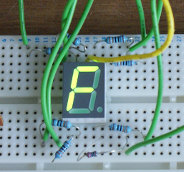
Arduino 7 segment LED display tutorial
In this tutorial I show you how to connect a 7 segment display to an Arduino board. For a tutorial showing how to drive 4 or 8 digit displays see ( Arduino multiple digit, 7 segment display tutorial ). Firstly, we must know what type of display we have as there are two possible forms, common cathode and common anode. If the...
Getting back into analog electronics
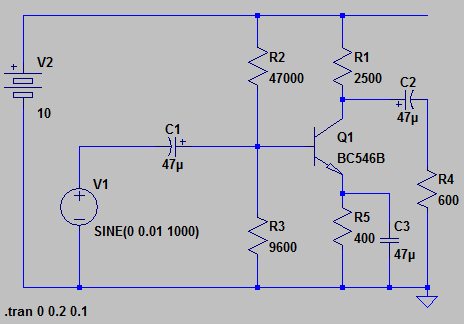
After a long pause, I've finally started to get back into analog electronics. I'm using the Introduction to Electronics and this blog as a way to help myself back up the curve. Below is my first working circuit, the good old class A amp. Twenty years ago I could have thrown together fairly complex circuits in short order. However, now it...
Introduction to Electronics
There are a few good books and websites that I recommend for people starting out with electronics. All about circuits Website that has several electronics books available online for free , these cover, DC theory, AC theory, semiconductors and digial electronics. DC covers voltages, currents, ohms law, conductors, insulators, batteries. Further it also covers network theory AC covers complex numbers,...
These may be of interest
- Similar - Write XML with GroovyBuilder
- Similar - Wrapping JFreeChart as a Groovy builder
- Similar - Reading XML in groovy using XmlParser
- Similar - Generate an ATOM feed with GroovyBuilder
- Similar - Groovychart Bar chart with fixed colour

Supporting us
We maintain several popular embedded projects and work hard to make them even better. If you're looking for commercial services, please do consider us.
Alternatively, you can buy us a coffee to say thanks.
Sharing links
Learn about TcMenu
We build and maintain an embedded menu designer and framework that works on many platforms.