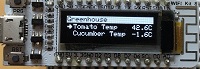
Heltek Wifi kit 8 pin outs marked wrongly on some silk screens
I recently bought a Heltek Wifi kit 8 and noticed that although the board itself seems to be a good board the pin-outs, both online and on the silk screen of the board are wrongly specified. For example the silk screen shows SDA and SCL on non standard pins, but this is not the case as far as I can tell....
Detecting power loss in a power supply
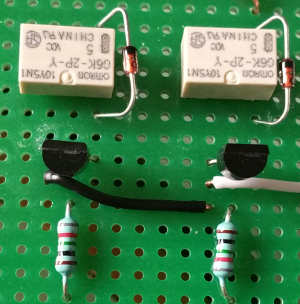
There are times when your program needs to react to your device being turned off, for example to save the current state of an Arduino sketch to EEPROM before shutting down, or to disengage relays in a power module to ensure there is a clean shutdown. Usually, the power loss detector is designed as part of the power supply, so...

Arduino digital input and output tutorial
In this tutorial and accompanying youtube video (left), I discuss how Arduino inputs and outputs work. Arduino 8 bit boards are mainly based on Atmel AVR chips, in fact the Mega is named after the chip number AVR-Mega-2560. Outputs on the AVR chips are much more versatile than they first look, and the video covers this in detail. If you are...
IO abstraction: the same code for pins, shift registers and i2c IO
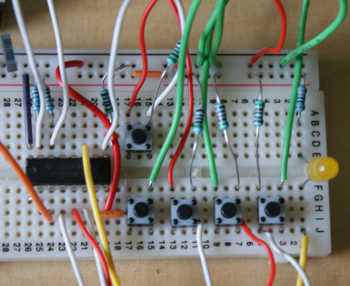
When writing Arduino code that needs quite a few IO pins, you may need to expand the IO using a shift register or i2c expansion device such as the PCF8574. Up until now that meant significantly changing your code to use the new device. If you were using the IOAbstraction library , then you'd just set up a different type of...

Arduino Game library for 20x4 display
Here we discuss a game library that provides an easy way to write games with 20x4 parallel display and a few micro-switches. There is quite a lot of stuff going on in this library, so I'd like to start slow and build up. First, let's start by taking a look at the parts needed to use this library: 20x4 display (other...
Low power Arduino menu using tcmenu library
In this article we'll discuss building a low power Arduino menu using tcMenu library. We will use a TFT screen and a rotary encoder connected to a PCF8574 device. The device will be SAMD MKR board. I've picked this choice purposely, because it's non-trivial, and requires a lot of digging to make sure power usage is a low as possible. Running...

Working with and de-bouncing switches for Arduino
When we press a button that's connected to an Arduino input, it is likely that the button will momentarily "flicker" between the on and off state. This gives false readings for a short period of time after the button is pressed. Problems caused by this can range from the mild annoyance of a slight flicker, to doing something more than once...

Java development for Raspberry PI using an IDE
If you're anything like me, you'll probably want to develop any large Java application using a fully fledged IDE such as IntelliJ or Eclipse. However, these are probably better run on another computer if available, transferring the code onto the PI. This article shows how to use maven to do fast turn around development onto a PI from a laptop....

Buffering an arduino output pin for more power
There are some occasions when the amount you safely draw (assume 20mA) from an Arduino board pin is just not enough (and some Arduino boards have even lower current capability). In these cases the output needs to be buffered in order to provide more power. At this point there are several possibilities, including ready made buffer chips such as the ULN2003A....
Basic current sensing on Arduino
I've got a side project of building a digitally Arduino controlled PSU that also includes an accurate component tester. In order to do this I'll have to be able to monitor the current flowing through a circuit, so I'd need some way of monitoring this. Before continuing, I'd like to say that is not an exemplar of how to build a...
These may be of interest
- Similar - Write XML with GroovyBuilder
- Similar - Wrapping JFreeChart as a Groovy builder
- Similar - Reading XML in groovy using XmlParser
- Similar - Generate an ATOM feed with GroovyBuilder
- Similar - Groovychart Bar chart with fixed colour

Supporting us
We maintain several popular embedded projects and work hard to make them even better. If you're looking for commercial services, please do consider us.
Alternatively, you can buy us a coffee to say thanks.
Sharing links
Learn about TcMenu
We build and maintain an embedded menu designer and framework that works on many platforms.