
TaskManagerIO
Loading...
Searching...
No Matches
#include <TaskTypes.h>
Public Member Functions | |
| BaseEvent (TaskManager *taskMgrToUse=&taskManager) | |
| virtual uint32_t | timeOfNextCheck ()=0 |
| void | setTriggered (bool t) |
| bool | isTriggered () const |
| bool | isComplete () const |
| void | setCompleted (bool complete) |
| void | markTriggeredAndNotify () |
| Public Member Functions inherited from Executable | |
| virtual void | exec ()=0 |
| virtual | ~Executable ()=default |
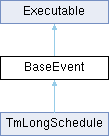
BaseEvent objects represent events that can be managed by task manager. We can create a base event as either a global variable, or as a new object that lasts at least as long as it's registered with task manager.
Events work differently to other tasks, there are two methods to implement, the first method timeOfNextCheck is for events that are polled, and you control how often it is polled by the value you return. To trigger an event you can call setTriggered(bool), and this will set a flag that task manager will look at during the next poll. If you are in the timeOfNextCheck and you set the event as triggered, it will execute immediately. If you are in an interrupt triggered by task manager, it will act on the trigger immediately. However, in other cases you can call markTriggeredAndNotify which additionally notifies task manager, making the effect immediate.
|
pure virtual |
This method must be implemented by all event handlers. It will be called when the event is first registered with task manager, then it will be called in whatever number of micros you return from the call. For polling events you'd set this to whatever frequency you needed to poll on. For interrupt / threaded situations, it may be set to a very large value, as you would not need to poll.
Implemented in TmLongSchedule.
|
inline |
Set the event as triggered, which means it will be executed next time around. Usually prefer to use markTriggeredAndNotify as this also notifies task manager.
|
inline |
|
inline |
|
inline |
Sets the task as completed or not completed. Can be called from interrupt safely. Warning once this is called assume that task manager will remove this from the queue immediately. Further, if deleteWhenDone was true, the object would be deleted almost immediately.
| ISR_ATTR void BaseEvent::markTriggeredAndNotify | ( | ) |
Set the event as triggered and then tell task manager that the event needs to be re-evaluated. It will not run immediately, rather it will do the equivalent of triggering an interrupt through taskManager. If this event already receives an interrupt through task manager, then there is no need to call notify.